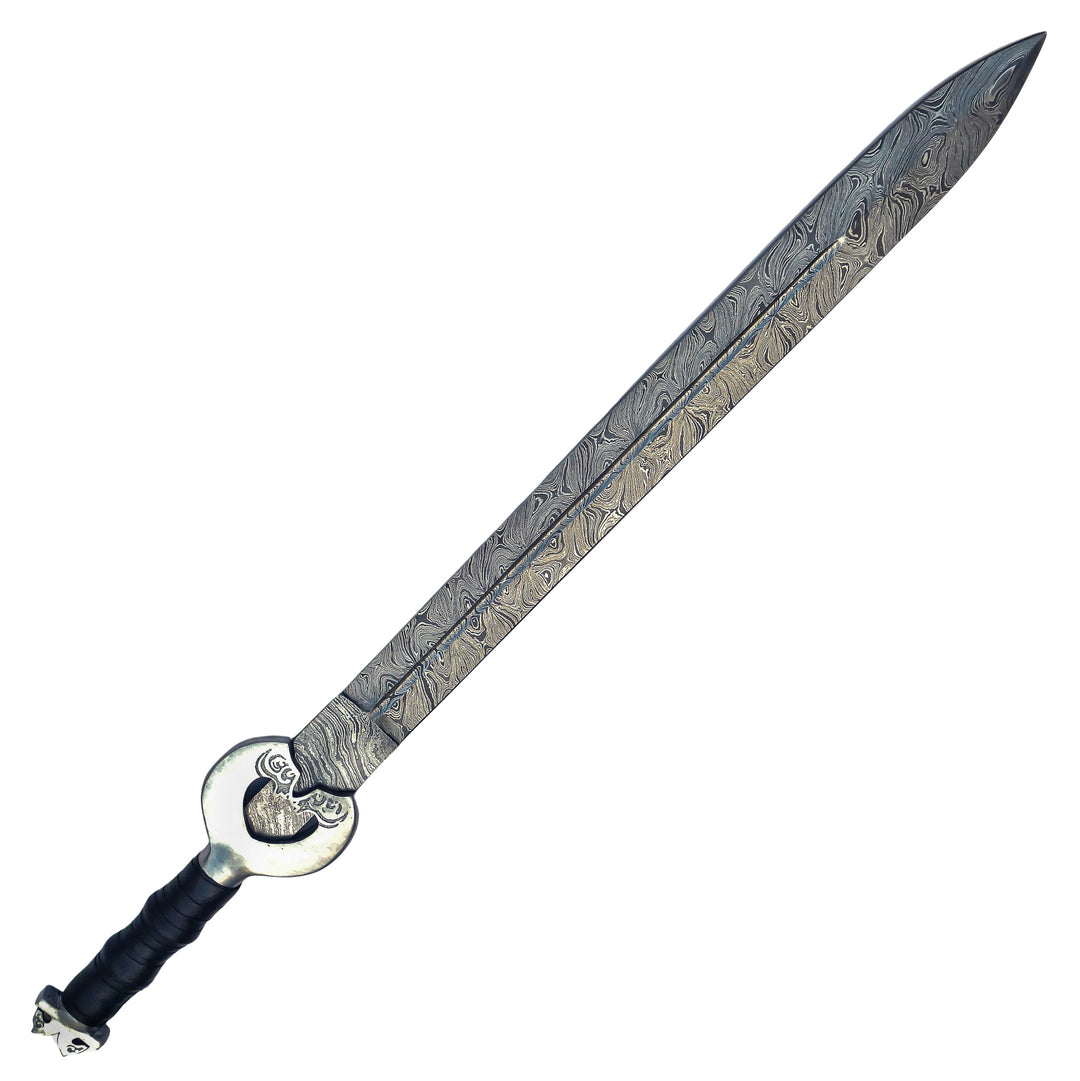
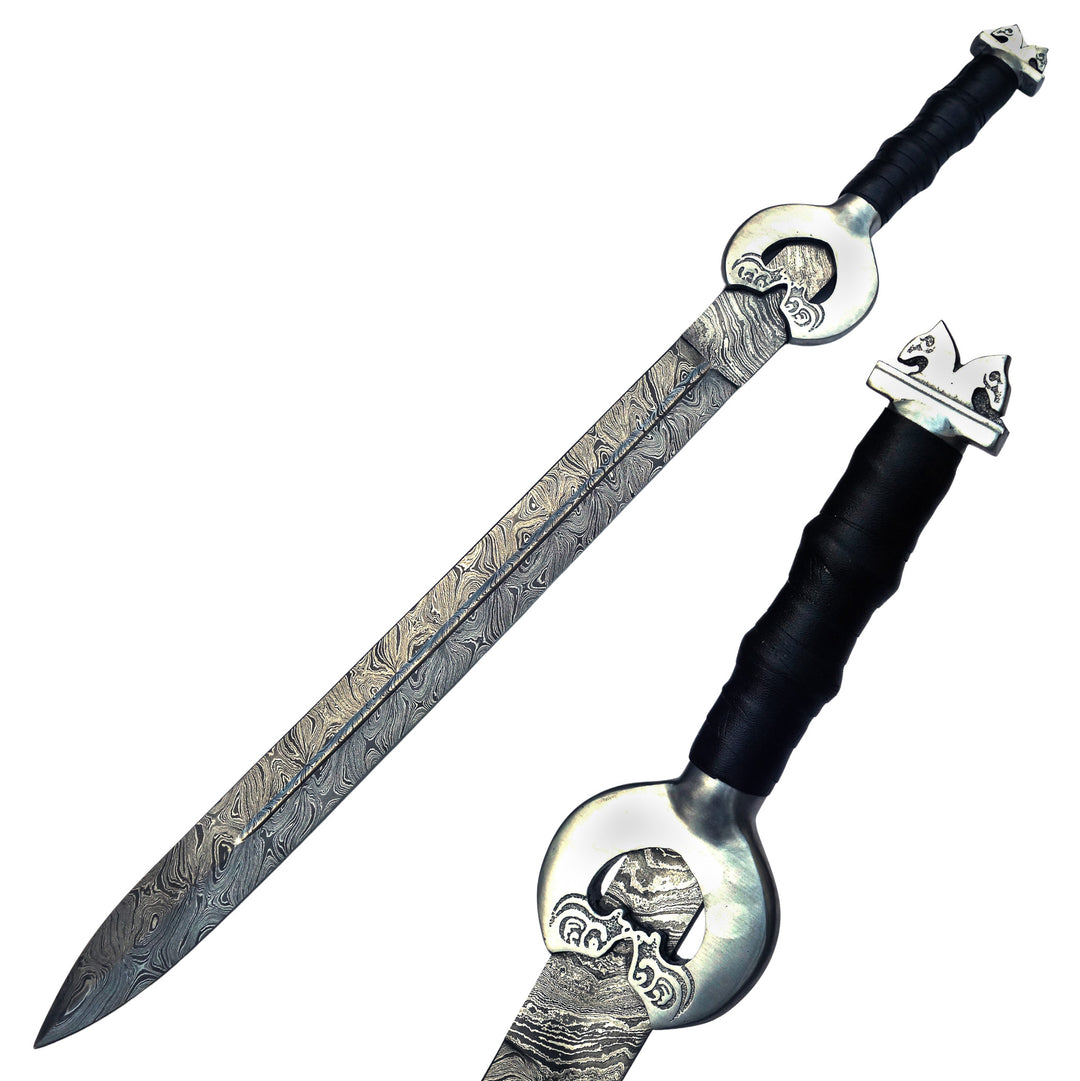
A 37-inch Spanish longsword in pattern-welded Damascus
steel, with a horse-head guard, brass bolsters and a fitted leather sheath.
Named for Rodrigo Díaz de Vivar — El Cid — and the sword he is said to have
carried.
Specifications
-
Length: 37"
-
Blade: Pattern-welded Damascus, 352 layers, double-edged
-
Steel: 1095 high-carbon with folded carbon steels (#40, #43)
-
Hardness: 55–56 HRC
-
Guard: Twin horse heads
-
Grip: Steel with brass bolsters
-
Included: Leather sheath
El Cid and Tizona
Rodrigo Díaz de Vivar died in 1099, and by then he had already become
something other than a man. Castilian by birth, he fought for Christian and
Muslim rulers in turn, took Valencia, and ended his life ruling it. The
Moors called him el sidi, the lord. Spain has called him El Cid ever
since.
The Cantar de Mio Cid gives him two swords: Colada, taken from the
Count of Barcelona, and Tizona — firebrand — won from
the Almoravids. Tizona is the one that survived. It hangs today in the Museo de
Burgos, a blade of 93.5 cm weighing just over a kilogram.
Its authenticity has been argued over for a century. A 2001 examination by
the Complutense University of Madrid concluded the blade could genuinely be
eleventh-century, though the hilt was replaced under the Catholic Monarchs some
four hundred years later. Other scholars call the whole thing a sixteenth-century
forgery. The argument has never been settled, which is arguably the most fitting
thing about it.
What this sword is
This is a tribute piece, not a museum copy. Tizona is an eleventh-century
blade; the cruciform two-handed longsword belongs to the centuries after it. What
this sword takes from El Cid is the character — Spanish, straight, double-edged,
built for use rather than display.
The guard carries twin horse heads, which is the detail most people notice
first and the one that ties it to the story: no knight of the period is more
closely associated with his horse than El Cid was with Babieca.
The Damascus
The blade is forged from a billet of eleven steel pieces — six of carbon
steel and five of 1095 — folded five times to reach 352 layers.
The 1095 carries the edge; the folding gives the blade its figure and its
resilience. Every billet is worked by hand, so no two are alike.
At 55–56 HRC the blade holds an edge while retaining enough flex to take
hard contact without cracking. That range is a deliberate compromise: harder
steel takes a finer edge but becomes brittle in a blade this long.
Care
Damascus is carbon steel and will rust if neglected. Wipe the blade dry after
handling, keep a light film of oil on it, and store it out of the sheath in damp
conditions. The etched pattern softens over years and can be brought back; our
guide on
re-etching
Damascus steel covers how.
What it's for
Collecting, display and re-enactment. Browse the full
longsword collection, or read our guide to
bastard
sword vs longsword.