Fast & Free Shipping

30 day Money Back

Secure Checkout


Longswords, katanas, Viking swords, gladius, rapiers, claymores, cutlasses and more, in 1095 high-carbon, Damascus, and stainless steel. Can't find what you're after? Build a custom sword.
The swords on this page are made in 1095 high-carbon, Damascus, and stainless steel. Most are hand-forged; some designs are machine made. Steel, tang construction, and fittings vary by design, so check the product page for the specification of any sword you are considering. Nearly all come with a scabbard. Here is how to choose.
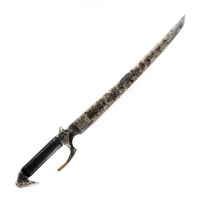
Damascus is not one steel. It is many steels forged into one. Ours starts as eleven separate pieces, five of them high-carbon 1095 and the rest carbon steels chosen to work with it. They are forge-welded, drawn out, folded and welded again, five folds in all, until the bar carries 352 distinct layers.
That process is the whole point, and it is where the quality of the raw material shows. Cheap Damascus is welded from whatever will bond, and while the pattern looks the part, the blade underneath does not. Ours is built from high-carbon stock chosen for how it behaves after the forge, which is why the finished blade lands exactly where a blade should sit: hard enough to take a keen edge and hold it through years of use, and springy enough to flex under load and come back straight rather than chipping or taking a permanent bend. Hardness on its own gives you a brittle blade. Flexibility on its own gives you a soft one. Folding is how smiths reconciled the two for more than a thousand years, and nobody has improved on it since.
Those layers are visible in the finished steel as a flowing pattern, and because it is forged into the blade rather than etched onto the surface, it runs the full depth of the steel. No two are alike. Looked after, a Damascus blade will outlast the person who buys it. These are pieces that get handed down.
Carbon is what lets steel be hardened and tempered at all. A high-carbon blade, folded Damascus or single 1095, can be brought to a genuine working hardness, will hold an edge, and can be resharpened for a lifetime. Every serious blade tradition in history was built on high-carbon steel, and it is still the line between a forged blade and an ornament.
1095 high-carbon steel is the classic single steel: high carbon, clean satin finish, and the backbone of the American blade tradition. Simpler than Damascus, and outstanding in its own right. Stainless steel trades some of that carbon for corrosion resistance, so it asks the least of you in upkeep. Our sword steel guide compares all three in detail.
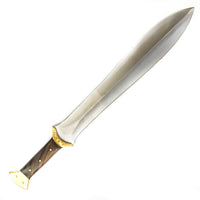
One-handed European and Mediterranean forms include the Viking sword, gladius, cutlass, Greek xiphos, and arming sword. Hand-and-a-half forms include the bastard sword, longsword, and katana. The two-handers — the claymore, zweihander, greatsword, and giant swords — are the showpieces that anchor a wall. Curved, single-edged blades include the scimitar, saber, and falchion, while the narrow, sharply pointed rapier represents the thrusting tradition. Chinese, Iberian, wakizashi, and fantasy swords round out the catalog.
Three things separate a forged sword from a decoration. A full tang: the blade steel runs the entire grip and anchors at the pommel as one piece. The product page states the tang construction for each sword. A stated steel grade: if a listing does not name its steel, assume the worst. A described heat treatment: a hardened and tempered blade bends and returns, while an untreated one stays bent or snaps. Our battle-ready guide explains what the term does and does not mean.
If the sword you want is not here, build it. The custom sword builder lets you choose the blade type, steel, guard, grip, pommel, scabbard, and engraving, or submit your own design from a drawing or photo. Custom swords are made to order in the same 1095 and Damascus steel as the catalog.
Where is the best place to buy a sword? From a seller that names its steel, states its tang construction, and stands behind the work. Every order is inspected before shipping, covered by our return policy, and backed by thousands of customer reviews. Order online or visit our showroom in Deerfield, Illinois.
What is the difference between 1095 and Damascus? Both are high-carbon steels that harden, hold an edge, and resharpen. 1095 is a single steel with a clean satin finish. Damascus is forged and folded from many layers, 1095 among them, which is what produces both its pattern and its balance of hardness and spring. Damascus is our flagship and our most popular choice.
How are these swords made? Battling Blades is a family-owned sword maker. Most blades are hand-forged to our specification in 1095 high-carbon or pattern-welded Damascus, with fittings that may include wood, leather, and brass; some designs are machine made. Where a piece is hand-made, small variations in pattern and finish are part of its character.
How do I care for a carbon steel sword? Wipe it after handling, keep a thin coat of oil on the blade, and store it dry. Our sword care guide and sharpening guide cover the rest, and the cleaning kits have everything you need.
Do you ship internationally? Yes. International buyers are responsible for checking their own country's import rules before ordering.
New to swords? Start with our beginner's buying guide, the labeled sword diagram, or the full library of guides.
"Comp. Value" is a reference value for this item or a substantially similar item. It may be based on one or more of the following: prior Battling Blades pricing, comparable products, supplier or manufacturer pricing, marketplace pricing, or other retail reference data. It is provided for comparison only and is not a claim that this exact item was previously sold at the Comp. Value, that the Comp. Value is an MSRP, or that any specific retailer currently charges that amount. We make no representation that a purchaser will realize savings equal to the difference between the Comp. Value and our price.