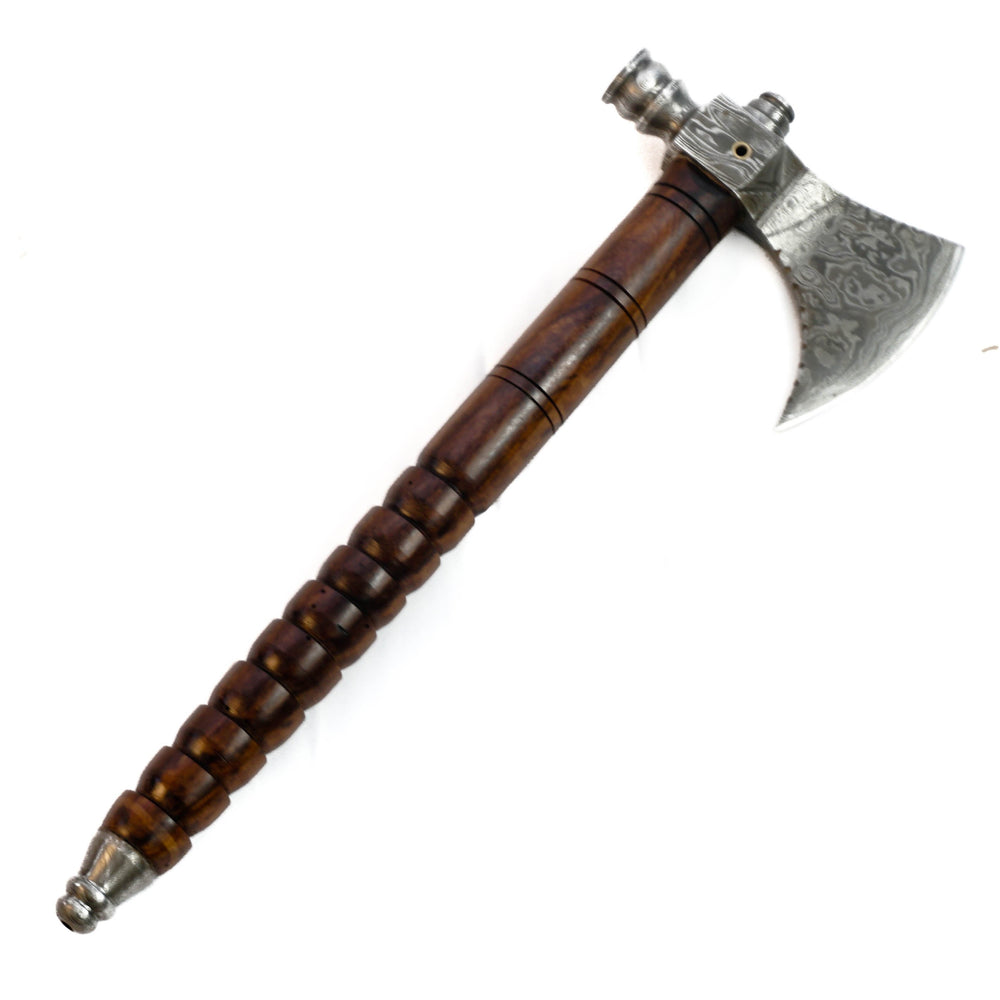
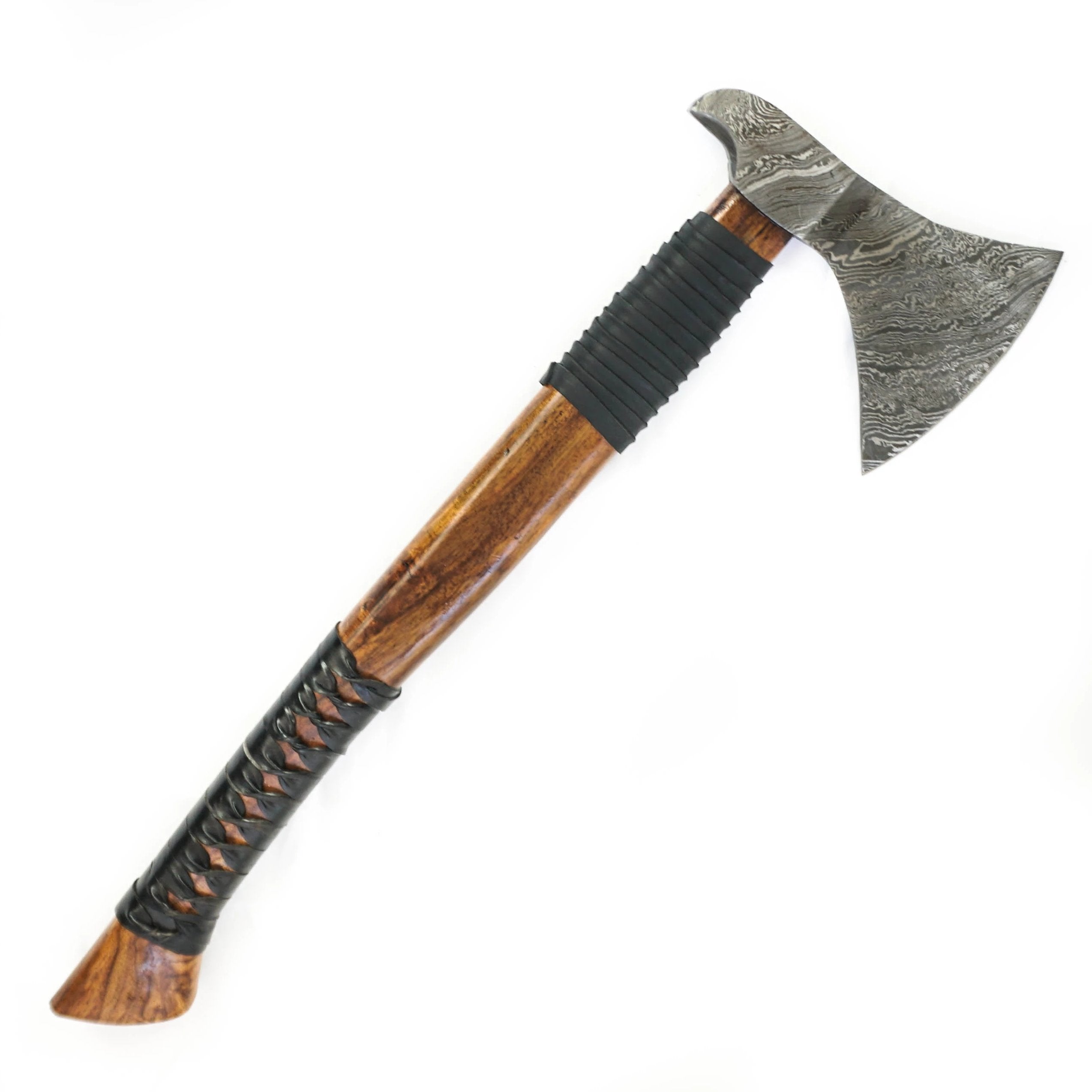
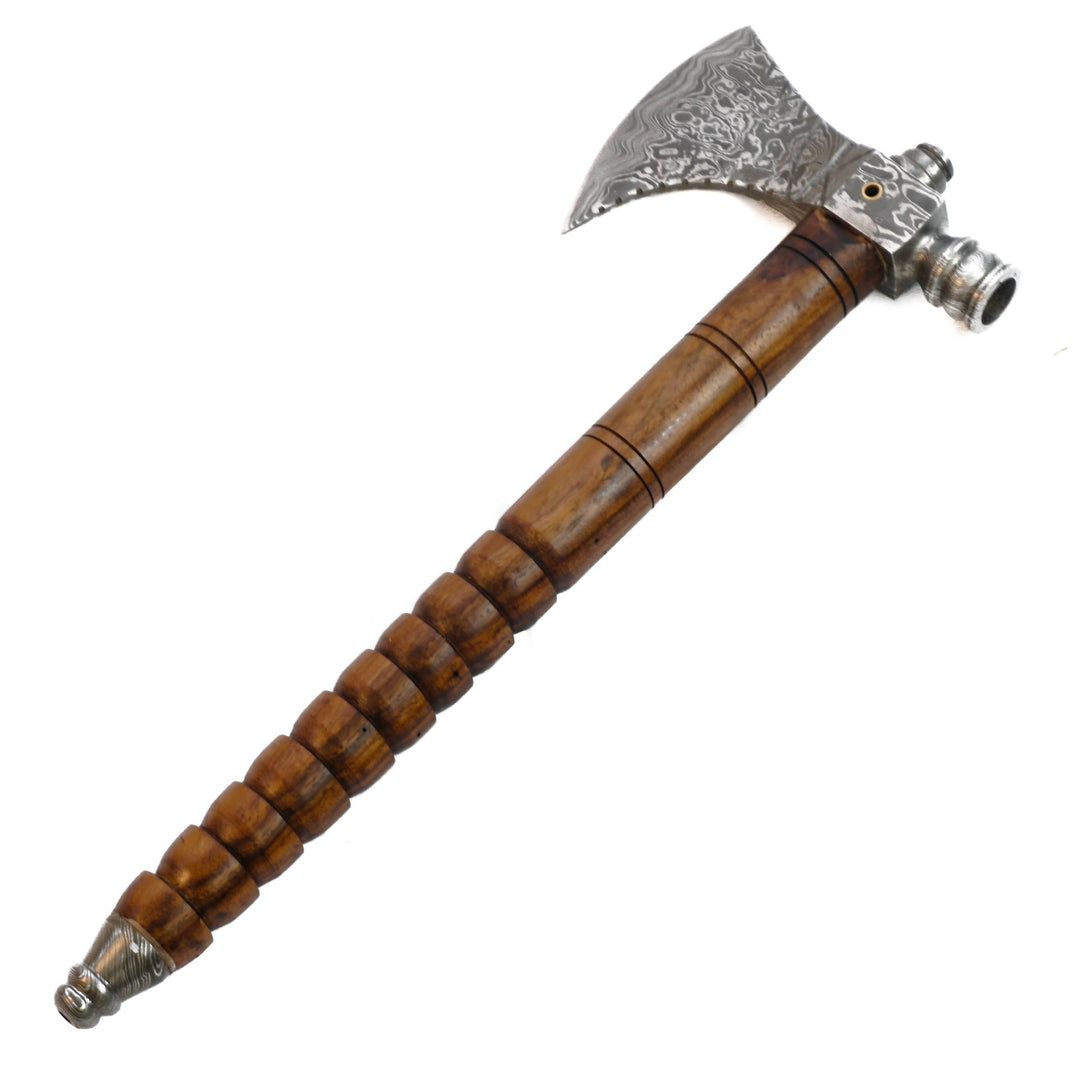
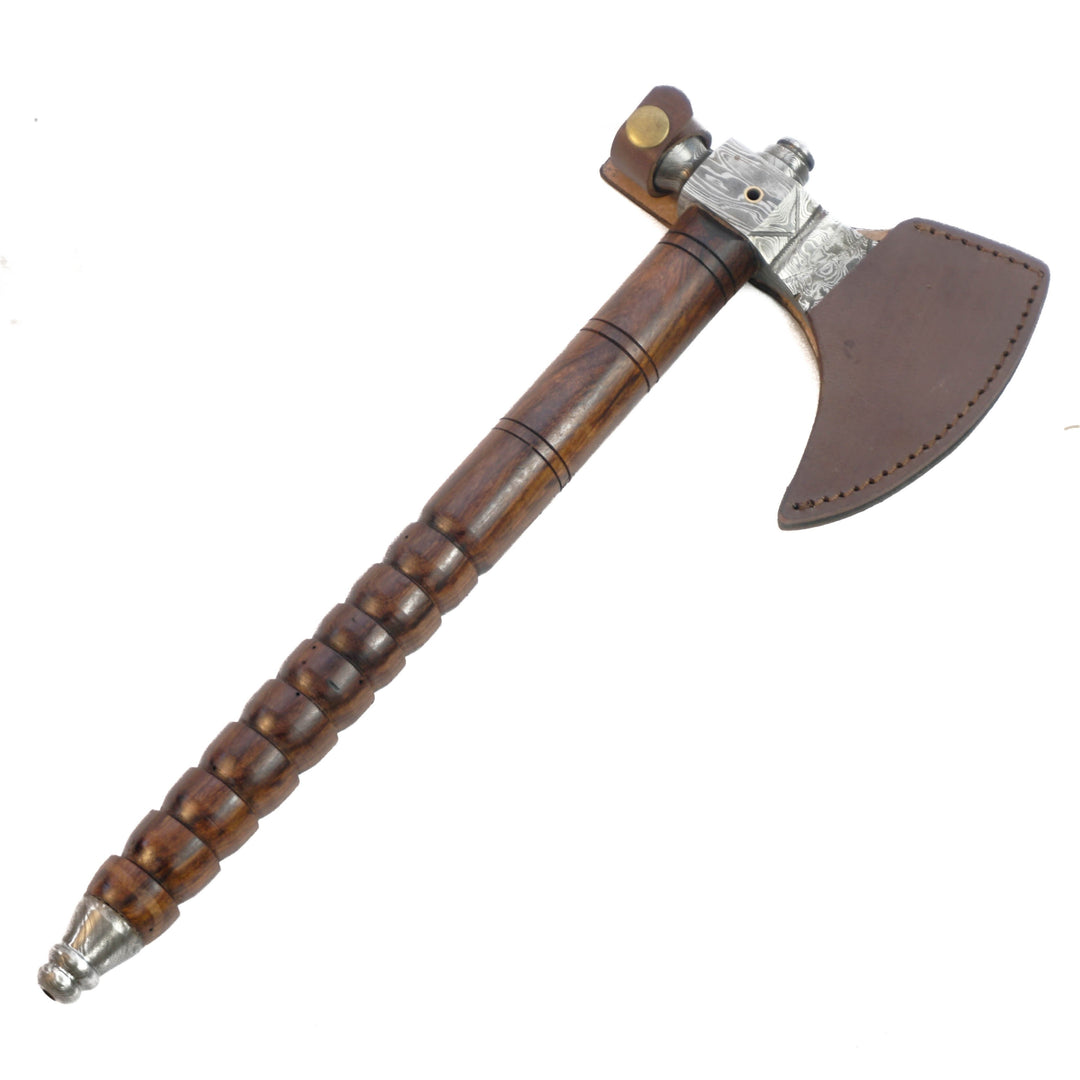
A hand-forged tomahawk with a 4" Damascus steel head on an
18" wooden haft, supplied with a fitted leather sheath. Light,
fast in the hand, and balanced the way a tomahawk should be — weight forward,
but not so far forward that it drags.
Specifications
-
Overall length: 18"
-
Head: 4", pattern-welded Damascus
-
Steel: 1095 high-carbon and carbon steels (#40, #43)
-
Hardness: 55–56 HRC
-
Haft: Wood
-
Included: Fitted leather sheath
Built to the historical proportions
Surviving tomahawks are remarkably consistent in size. Cutting edges are
rarely much longer than four inches, and hafts are almost always under two
feet — short enough to carry on a belt all day, long enough to deliver real
force one-handed.
At a 4" edge on an 18" haft, this piece sits squarely inside that range.
That is not a styling decision. A tomahawk with an oversized head stops
handling like a tomahawk and starts handling like a hatchet, and the
difference is obvious the first time you pick one up.
Where the tomahawk comes from
The word reached English in the 17th century from Powhatan
tamahaac, built on a Proto-Algonquian root meaning roughly "to cut
off by tool." Related words appear across the Algonquian languages — Lenape,
Abenaki, Malecite-Passamaquoddy — all of them simply meaning axe.
The earliest tomahawks were stone, bone or antler, shaped by knapping and
pecking and lashed to a wooden haft with rawhide. They were tools first:
splitting, cutting, driving, butchering. The weapon was the same object used
differently.
Everything changed with European contact. Traders introduced iron and
steel heads — the earliest patterns drawn from the Royal Navy boarding axe —
and metal tomahawks became one of the most sought-after goods in the fur
trade. The form spread far beyond the peoples who named it. Colonists carried
them. So did frontiersmen. The British Army issued them to colonial regulars
during the American Revolutionary War.
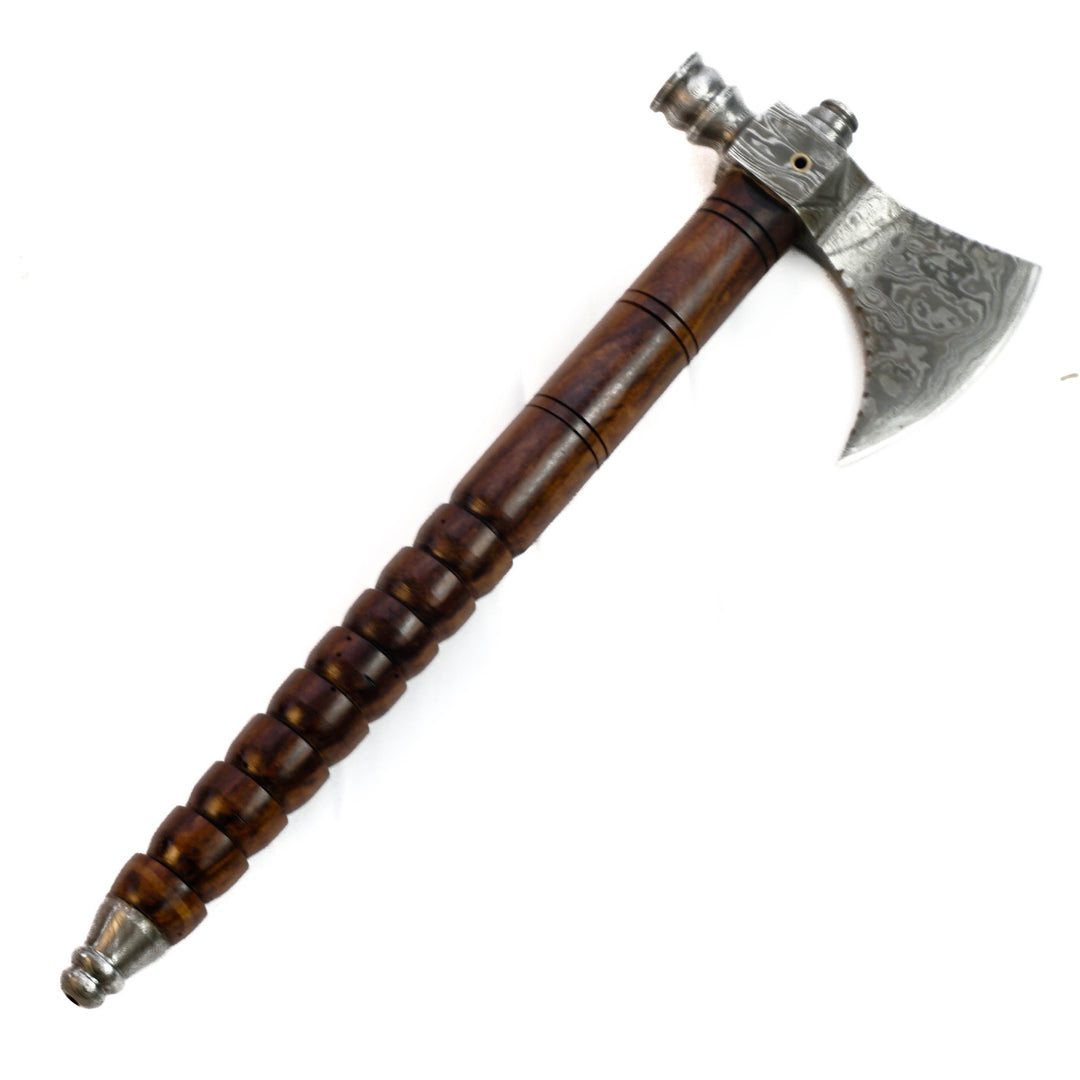
The strangest object in the tomahawk's history is the pipe tomahawk: a
smoking bowl on the poll and a hollowed haft for a stem, so one end was a
pipe and the other an axe. Made by Europeans as trade goods but most often
given as diplomatic gifts, it put the whole choice of the encounter into a
single object — peace at one end, war at the other. Nothing quite like it
exists outside North America.
The form never really went out of service. American troops carried
tomahawks in Vietnam, and again in Afghanistan, where the pattern was issued
formally enough to be classified by NATO as rescue equipment. Very few
weapons of the 1600s can say that.
The Damascus
The head is forged from a billet of eleven steel pieces — six layers of
carbon steel and five of 1095 — folded five times to reach
352 layers. The 1095 carries the edge; the folding gives the
head its pattern and its resilience under repeated impact. Every billet is
worked by hand, so no two heads carry the same figure.
At 55–56 HRC the head is hard enough to hold an edge and forgiving enough
to absorb a missed strike without chipping. That range is a deliberate
compromise — a harder head takes a finer edge but is far less tolerant of
hitting wood at speed.
Care
Damascus is carbon steel, so it will rust if neglected. Wipe the head dry
after use, keep a light film of oil on it, and store it out of the sheath in
damp conditions — leather holds moisture against steel. The etched pattern
softens over years of handling and can be brought back; our guide on
re-etching
Damascus steel covers how.
What it's for
Camp and field use, re-enactment, and collecting. It displays well, but
this is a working tomahawk, not a wall piece.
More on the history and its many uses in our guide to the
Native American tomahawk,
or browse the full axe collection.





 Fast & Free Shipping
 30 day Money Back Guarantee
 Secure Checkout