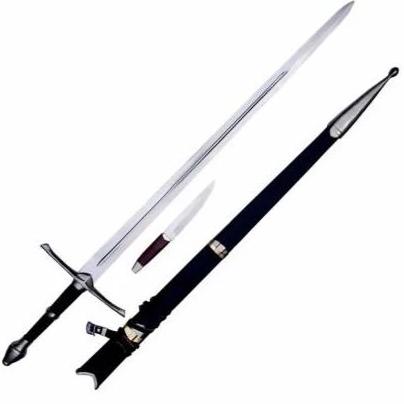
The Roman Spatha is one of the most consequential swords in Western history — the weapon that carried Rome from the tight shield walls of the Republic into the sprawling cavalry campaigns of the late Empire, and the blade that would go on to shape the Viking and medieval European swords that followed. This Battling Blades edition recreates that iconic longsword in hand-forged Damascus steel, measuring 43.5 inches overall, with the reach, balance, and presence that made the original a battlefield mainstay for more than a thousand years.
A Sword That Outlived an Empire
The spatha began as a cavalry weapon. Roman horsemen — many of them Celtic and Germanic auxiliaries — needed more reach than the short, stabbing gladius could offer, and by the 1st century C.E. the longer spatha had become their sword of choice. Its advantage was obvious: a rider or a soldier in looser open-order formations could cut and thrust at distance rather than being locked into the close press the gladius was designed for.
As Roman tactics shifted over the 2nd and 3rd centuries — away from rigid legionary lines and toward more mobile, mixed forces — the spatha moved from the saddle to the infantry line, gradually replacing the gladius as the standard sidearm of the Roman soldier. Legions on the Rhine and in the campaigns into Germania carried it into some of the Empire's hardest-fought frontiers.
Its influence didn't end with Rome. As the Western Empire dissolved, the spatha's long, straight, double-edged form was carried forward by Germanic and Frankish smiths, evolved through the Migration Period, and became the direct ancestor of the Viking sword. From there the lineage runs straight into the Norman and medieval knightly swords of the 11th and 12th centuries — the crossguard, the grip, and the tapering blade all trace back to this single Roman design. Few weapons can claim to have shaped an entire millennium of European swordsmithing. The spatha is one of them.
Forged in Damascus Steel
The blade is pattern-welded Damascus steel, forged the traditional way: eleven bars of steel folded five times to build 352 distinct layers, then acid-etched to reveal the flowing, organic grain that no two blades share. Every spatha that leaves the forge carries its own one-of-a-kind pattern.
At the heart of the billet is high-carbon 1095 steel, prized by bladesmiths for its purity and edge retention. The folding process marries that hard, keen-edged steel with tougher layers, producing a blade that holds a sharp, durable edge without becoming brittle — the classic balance of hardness and resilience that made forge-welded blades legendary. Heat-treated to a Rockwell hardness of 55–56 HRC, it sits in the sweet spot for a working sword: hard enough to take and keep an edge, tough enough to flex and absorb impact rather than crack.
Specifications
-
Overall Length: 43.5 inches
-
Blade: Pattern-welded Damascus steel — 352 layers from 11 bars, folded 5 times
-
Core Steel: High-carbon 1095
-
Hardness: 55–56 HRC
-
Handle: Traditionally styled hardwood grip for a secure, comfortable hold
-
Tip Options: Infantry (pointed, for thrusting) or cavalry (rounded)
-
Included: Durable leather scabbard for safe storage and transport
-
Best For: Collectors, historical reenactment, martial display, and gifting
Two Tips, Two Roles
Authentic to the original, this spatha is offered in two configurations. The infantry version carries a sharp, pointed tip built for the thrust — the killing stroke of the foot soldier. The cavalry version wears a rounded tip, a practical touch from the era that kept a mounted warrior from accidentally injuring his own horse in the chaos of a charge. Choose the profile that fits your collection or your reenactment impression.
Why Buy From Battling Blades
Every sword we offer is inspected for fit, finish, and forge quality before it ships. This is a hand-forged Damascus piece, not a mass-stamped replica — the layered steel, the leather scabbard, and the historical accuracy make it as satisfying to display on the wall as it is to handle at an event.
Frequently Asked Questions
Is this Roman Spatha battle-ready or display-only?
It's a functional, full-hardness 1095 Damascus blade at 55–56 HRC, well suited to reenactment cutting and handling as well as display. As with any collectible sword, we recommend responsible use and proper training for any cutting practice.
What is Damascus steel, and is every blade the same?
Damascus (pattern-welded) steel is made by forge-welding and folding multiple layers of steel together — here, 11 bars folded into 352 layers. The etching reveals a unique flowing pattern, so no two blades are identical. Yours will be one of a kind.
Should I choose the pointed or rounded tip?
Choose the pointed (infantry) tip if you want an authentic thrusting profile or a more aggressive display piece. Choose the rounded (cavalry) tip for a historically accurate mounted-warrior impression or if you prefer a safer point for handling and events.
How do I care for a high-carbon Damascus blade?
1095 is a high-carbon steel and can rust if neglected. Wipe the blade down after handling, keep a light coat of oil on it, and store it in a dry place. Avoid leaving it sheathed in the leather scabbard long-term in humid conditions, as trapped moisture can promote corrosion.
Does it come with a scabbard?
Yes — every spatha ships with a durable leather scabbard for protection and easy transport.
What is the overall length?
The sword measures 43.5 inches overall, giving it the extended reach that made the historical spatha more versatile than the shorter gladius it replaced.
Is this a good gift for a history or sword enthusiast?
Absolutely. Between its one-of-a-kind Damascus pattern, its deep historical pedigree, and the included scabbard, it makes a standout gift for collectors, reenactors, martial artists, and anyone drawn to Roman or medieval history.



 Fast & Free Shipping
 30 day Money Back Guarantee
 Secure Checkout
