
What Is a Carolingian Sword? History, Design, Battle Use, and the Viking Connection
The Carolingian sword is the blade behind two reputations at once. It was the sword of Charlemagne's Frankish Empire, carried by the armies that built medieval Europe — and, exported in defiance of royal bans, it became the sword the Vikings carried on every raid of the next two centuries. "Carolingian sword" and "Viking sword" are, in most cases, two names for the same weapon. This guide covers what it was, where it came from, how it was built, what it was used for, why it worked so well in battle, and how to choose a replica.
What Is a Carolingian Sword?
A Carolingian sword is the straight, double-edged, one-handed sword of Western and Northern Europe from roughly 750 to 1000 AD — the period of the Carolingian dynasty, named for Charlemagne (Carolus Magnus), which ruled the Frankish Empire from 751 until the late 10th century. The type is defined by a broad blade of 28 to 35 inches with a wide fuller, a short straight cross guard, a one-handed grip of about 4 inches, and a heavy pommel — lobed, brazil-nut, or "tea-cosy" shaped. Overall length ran 35 to 40 inches and weight about 2.2 to 3 pounds. It is the direct descendant of the late Roman spatha through the Merovingian swords of the early Franks, and the direct ancestor of the knightly arming sword of the High Middle Ages.
Carolingian Sword or Viking Sword?
Both. The Franks made the swords; the Norse bought, stole, and were buried with them. The finest workshops were in the Rhineland, and the famous Ulfberht and Ingelrii blades are Carolingian swords by origin and Viking swords by ownership. Charlemagne's capitulary of 805 banned selling weapons to the empire's enemies, and Charles the Bald's Edict of Pîtres in 864 made selling arms to the Northmen punishable by death; the bans failed so completely that most surviving Carolingian swords have been excavated in Scandinavia. Historians use "Carolingian" to stress the sword's Frankish origin and "Viking" to stress who carried it. The Norwegian archaeologist Jan Petersen's 1919 typology of these swords by hilt shape (Types A through Z) applies to both, and the blades are the ancestors of Ewart Oakeshott's Type X, the first medieval sword in his system.
History of the Carolingian Sword
Under Charlemagne (768–814) the Frankish army became the dominant military force in Europe, and its standard sidearm was standardized with it. Frankish smiths improved on Merovingian pattern-welding, produced swords in something close to volume, and signed their best work with inlaid names — the earliest trademarks in European arms. Charlemagne's own sword, Joyeuse, survives in legend and in a much-rebuilt form in the Louvre, where it served as the coronation sword of French kings for centuries. As the empire fragmented after 843, the sword outlived it: Carolingian-pattern blades remained standard across Francia, England, and Scandinavia into the 11th century, when longer guards and tapering blades turned them into the arming sword of the Norman era.
Design and Construction
The blade was the point of the sword: broad, parallel-edged for most of its length, with a rounded or only slightly pointed tip, because the Carolingian sword was a cutting weapon. The wide fuller cut up to a third of the weight while keeping the blade stiff. Most blades were pattern-welded — strips of iron and steel twisted and forge-welded into a core, with harder steel edges welded on — producing both strength and the rippled surface visible after polishing. The elite blades were better still: Ulfberhts were made from crucible steel with three times the carbon of an ordinary sword. Hilts were simple and functional: a short, straight guard to stop the hand sliding onto the edge, a leather- or wire-wrapped grip, and a heavy pommel that balanced the blade a few inches in front of the guard. Our guide on how Viking swords were forged covers the process step by step.
What the Carolingian Sword Was Used For
Shield-wall combat. Frankish and Norse infantry fought behind round or kite shields in close ranks. The sword was used in the moments the shield line opened: a one-handed cut over or around the shield, aimed at the head, neck, arm, or leg. The short guard did not matter, because the shield did the defending.
Cavalry. Charlemagne's armies relied heavily on mounted troops, and a long straight cutting blade is the ideal horseman's weapon. The sword's length and balance let a rider cut downward at infantry while keeping his hand well back.
Against the armor of its day. Most opponents wore no armor or a mail shirt over padding. A heavy cut from a Carolingian sword could break bones through mail and kill outright where mail was absent. The sword did not need a point to defeat plate, because plate did not exist yet; its broad cutting edge was exactly the right tool for its century.
Status, ceremony, and burial. A sword cost as much as a farm. Laws limited who could carry one, oaths were sworn on them, kings gave them as rewards, and warriors were buried with them — which is why so many survive. In Norse custom a sword passed from father to son with a name attached, and the sagas treat famous swords almost as characters.
Why It Was So Effective
Balance came first. At 2.5 pounds with the weight pulled back toward the hand by the pommel, a Carolingian sword could be moved from the wrist and recovered quickly after a cut, which matters in a shield wall where a slow recovery is fatal. Versatility came second: the same sword served on foot, on horseback, and from the deck of a ship. Build quality came third: pattern-welded blades with hard edges and tough cores bent rather than broke, and the best were the finest steel in Europe. And the broad, heavy cutting blade was perfectly matched to lightly armored opponents. Later swords were better against plate; none was better at what this sword was for.
Carolingian Sword vs. Other Medieval Swords
Against the Roman spatha, the Carolingian sword is the same idea with a better hilt and often better steel. Against the arming sword that followed, it is shorter in the guard, broader and less pointed in the blade, and balanced more for the cut. Against the later longsword it is lighter, one-handed, and built for use with a shield rather than in both hands. Our guide to the types of Viking swords covers the Petersen types in detail.
Owning a Carolingian Sword Today
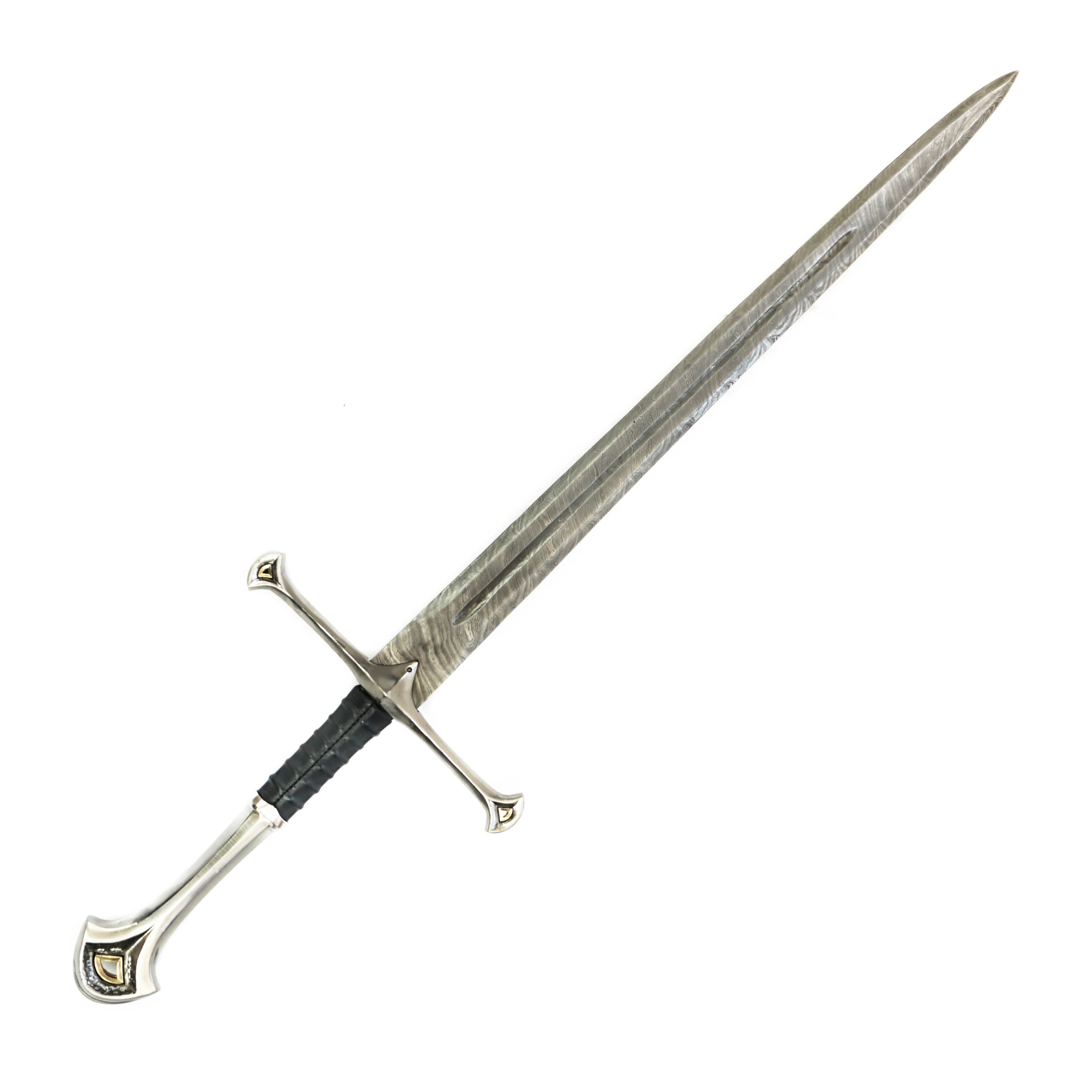
For collectors, reenactors, and HEMA practitioners, the Carolingian sword is the authentic choice for the whole span from Charlemagne to the Norman Conquest, and it is one of the most comfortable swords to handle. Ours are hand-forged in 1095 high-carbon and pattern-welded Damascus steel with full tangs, historically shaped guards and lobed pommels, sharpened, with scabbards included. See the 39-inch Damascus Carolingian sword and the 37-inch folded Damascus Carolingian, browse the full Viking sword collection, or build your own Viking sword. Look for a full tang, a stated high-carbon steel, and a described heat treatment; our Viking sword buyer's guide covers the rest.
Carolingian Sword FAQ
What is a Carolingian sword?
The straight, double-edged, one-handed sword of the Frankish Carolingian Empire and its neighbors, used from about 750 to 1000 AD. It descends from the Roman spatha and is the ancestor of the medieval arming sword.
Is a Carolingian sword the same as a Viking sword?
Essentially yes. The Franks made them and the Vikings carried them; "Carolingian" names the origin and "Viking" names the most famous users.
How long and heavy was a Carolingian sword?
Blades of 28 to 35 inches, overall 35 to 40 inches, and 2.2 to 3 pounds — a light, fast one-handed sword.
What was a Carolingian sword used for?
Cutting from behind a shield in infantry combat, cutting from horseback, and as a symbol of rank, oath, and inheritance.
Was it effective against armor?
Against the mail and padding of its era, yes. It was a cutting sword built before plate armor existed and was not designed to thrust through it.
Was the Ulfberht a Carolingian sword?
Yes. The Ulfberht is the most famous Carolingian sword, made in the Frankish Rhineland from crucible steel and carried mostly by Norse warriors.
What was Charlemagne's sword called?
Joyeuse. A sword by that name, rebuilt over the centuries, is in the Louvre and was used in French coronations.